An official website of the United States government
A .mil website belongs to an official U.S. Department of Defense organization in the United States.
A lock (lock ) or https:// means you’ve safely connected to the .mil website. Share sensitive information only on official, secure websites.

Home : Library : Chairmans Leadership Library : History

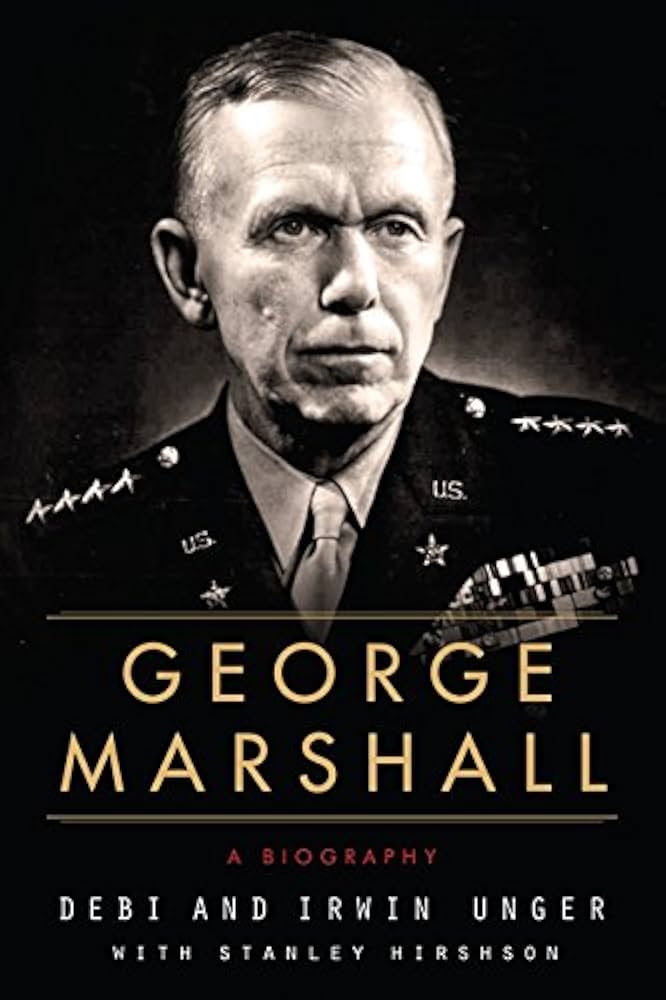
George Marshall: A Biography 

Debi Unger, Irwin Unger, and Stanley Hirshson

Summary: A detailed account of General George Marshall’s leadership before, during, and after World War II. It highlights his role in building the U.S. Army, managing coalition warfare, and shaping postwar recovery through the Marshall Plan.

Reasons to Read: Offers a model of strategic leadership, institutional stewardship, and talent management. Particularly relevant for Joint Force leaders operating at scale, demonstrating how to build effective organizations, develop subordinates, and align military efforts with national strategy.

Grant Takes Command

Bruce Catton

Summary: The book follows Ulysses S. Grant as he becomes general in chief in 1864, coordinating Union armies, partnering with Sherman and Meade, and pressing relentless campaigns that stretch Confederate resources. It highlights strategic unity, political pressure, and the grind of total war leading to eventual Union victory.

Reasons to Read: Essential for Joint Force leaders, the book demonstrates theater-level command, integration of multiple armies, and synchronization across vast distances. Grant’s approach to persistent pressure, logistics, and command relationships offers lessons for joint campaigning, unity of effort, and civil-military alignment under political scrutiny in protracted conflict against adaptive adversaries today environments.

The Quiet Americans

Scott Anderson

Summary: The Quiet Americans chronicles the rise of American intelligence and covert action during the early Cold War through the lives of four CIA officers. Scott Anderson shows how idealism, strategic competition, and secret operations shaped U.S. foreign policy, while exposing the successes, failures, and unintended consequences of American power abroad.

Reasons to Read: Illustrates how strategy, intelligence, diplomacy, and military power interact. The book highlights the costs of flawed assumptions, organizational bias, and poorly understood local conditions. Its lessons on decision-making, interagency coordination, and strategic consequences remain highly relevant today.

The U.S. Constitution 

U.S. Founding Fathers

Summary: The foundational document establishing the structure of the U.S. government, defining the separation of powers and the rule of law. It outlines authorities, rights, and responsibilities that shape national decision-making, including the legal framework governing the employment of military force.

Reasons to Read: Essential for understanding civilian control of the military and the legal basis for Joint Force operations. Provides critical context for authorities, interagency coordination, and decision-making boundaries that shape how military power is employed at the national level.

The Federalist Papers

Alexander Hamilton, James Madison, and John Jay

Summary: A collection of 85 essays advocating for the ratification of the U.S. Constitution and a strong federal government. Published between 1787 and 1788, these essays explain the principles behind the Constitution, address criticisms from Anti-Federalists, and lay the intellectual foundation for American political philosophy. The authors analyze governance, power distribution, and the role of federal authority in maintaining stability and security.

Reasons to Read: A foundation document that deepens understanding of the Constitution and foundational political ideas. It clarifies government structure, rights, and limits of power while sharpening critical thinking. Provides deep insight into the political framework guiding national security decisions. Helps Joint Force leaders better understand the strategic environment shaped by constitutional authority, federalism, and civil-military relationships.

Thinking in Time

Richard E. Neustadt and Ernest R. May

Summary: Explains how policymakers should use history rigorously when making decisions. It critiques simplistic analogies and introduces methods such as placing events in context, comparing cases systematically, and asking structured questions to extract relevant lessons rather than misleading conclusions in policy and strategy settings today and future environments.

Reasons to Read: Strengthens decision making, especially in complex strategic environments. It teaches disciplined thinking, helps avoid misusing historical examples, and sharpens the ability to question assumptions and frame problems clearly. Particularly valuable for military officers confronting uncertainty and high stakes choices today and tomorrow in practice.